

Walk the talk, don’t talk the walk. That’s what I posted recently when Facebook asked me what advice I tried to live by from my father, Paul. Truth be told, he probably didn’t say that exactly. He would have scoffed at the idea of providing sage advice. But truly he lived it. Quietly and humbly and without calling attention to himself. He did not believe you should talk about your good deeds. You should just do them.
His walking the talk took so many forms. To the blind and visually impaired kids in the Philly public schools, he walked that talk as the “Eye Guy.” Each day, he arose, pen behind ear, an appointment book clipped to mark the day’s commitments. His daily appointment book was flush full of people to see about getting David R. or Chantal L. or Freddie B. an after-school job, or a front-row seat in chemistry, or an application to a scholarship for college. He didn’t talk up the small achievements — the boy who made it to college because he pushed him to apply, the girl who kept the summer job and contributed to her family’s food budget for the week.
Sometimes, walking those streets took a toll, like the time he learned that one of his students had been shot the night before. Or the kid he had come to see was moved elsewhere — to another neighborhood — to foster care.
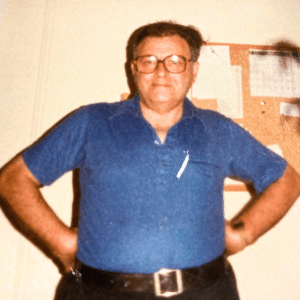
For me, Paul walked the talk throughout my early years in New York City. I moved a lot in those days. Each time I had to move, Paul would pull up to the stoop in his station wagon, with a mattress strapped to the top, carting endless boxes of books and records—my main possessions in those years—up and down those four-story walkups. It was sweat labor, and he never complained. Not about the baseball game on TV he was missing or the tickets he had to give up to the opera. At day’s end, we’d polish off the day’s special at the local diner, and off he’d go, for the drive back home.
Paul continued to walk the talk as a teacher, father, grandfather, and husband — even in retirement. Then one day he couldn’t walk at all. It started two years earlier. While reaching for a can on the top shelf of the pantry, he felt a weakness in his arm. He discounted it at first to the 30 laps he had swam at the Y pool the day before. But one week later, his arm still felt weak, and then two weeks and then three weeks, and then one month. When the weakness in his arm traveled down to his hand, he had to stop driving. Instead, he took the bus downtown to volunteer at the Library for the Blind.
By this point, he (and we) knew something was seriously wrong. One doctor’s visit led to another, and then to a neurologist, who after prodding and extensive testing, told him the weakness he felt was not from his laps in the pool. It was amyotrophic lateral sclerosis, Lou Gehrig’s disease. When Paul called to tell us all the news, he laughed. How ironic, he said, that an unathletic guy who preferred watching nine innings of a baseball game with the sound down and the radio tuned full blast to “Aida” would have a disease named for a famous baseball player.
With one hand fully inert, he continued to walk the talk. He could no longer drive to deliver the frozen chicken dinners to his meals-on-wheels recipients. So he’d sit at the dining room table, inserting single pieces of rye bread into packets that someone else would deliver to the seniors waiting for their weekly dinner.
In the months that followed, we watched helplessly as the disease crept from one part of his body to the next. His activities grew increasingly more limited, and he moved to a wheelchair. Never once did he bemoan his fate, at least not out loud.
Instead, he did something quite extraordinary. He started typing, first with two hands, and then with one hand, and then with whatever fingers worked for him, pecking out a story one key at a time. It was not just his story, but his family’s as well as my mother’s — their parents, grandparents, great grandparents, the cousins — whatever he knew about their lives in Russia, why they made hasty exits, and journeyed over rocky seas to new lives in America.
At some point, his fingers stopped working altogether. And so I became his muse. While his speech was still strong, he narrated his story and I typed. I learned more about those days before he married and became a father, especially his service in the army during World War II.
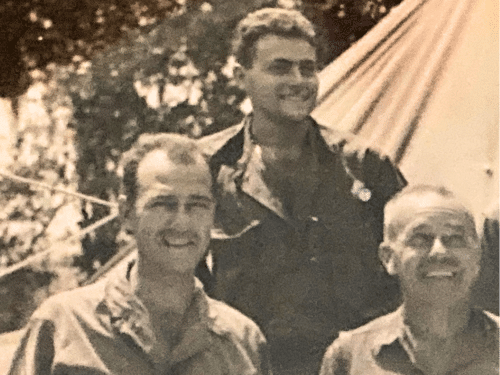
He wrote:
My total time in army service was just over three years and yet my memories of those years constitute a major portion of this autobiography. …The time I served represents only 4 percent of my present life. But I think that period was important for several reasons.
I took part in a great movement that brought the end of the axis power’s attempt of world domination. I lived away from an atmosphere of love and caring and culture, and yet was not disabled when I lived under different circumstances. I learned there are many bright and talented people, who because of their low expectations, accept a lesser job than they are capable.
Paul was more than 200 pages into his tale when he lost his ability to speak. I had to stop typing. He had already named his story: “My journey through the twentieth century.” His subhead, as if an afterthought, read: “This is a report of my unremarkable journey.”
His journey was hardly unremarkable. He had touched so many lives. Most assuredly, to the very end, he had walked the talk, not talked the walk.
Love you Dad. Happy Father’s Day.




Beautiful Fay.
Beautiful story, beautifully written! And as the author’s husband, I can personally attest that she also walks the talk in her own humble way.
What an inspiring story, Fay. Some heroes conquer challenges from a couch or a wheelchair and it sounds like your Dad was among the mighty. Lucky you to grow up as his daughter 🙂